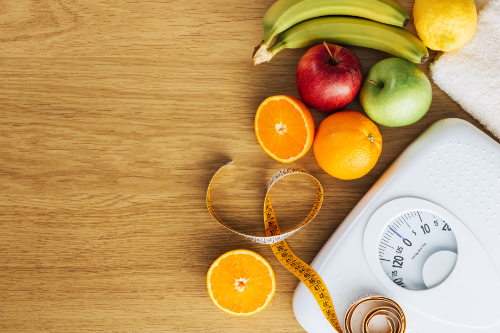
You’ve just lost weight and you don’t want to see that number go back up on your scale. Although gaining the weight back might feel inevitable, it doesn’t have to be. In fact, long-term weight maintenance is possible — if you follow these key behaviors.
Build more lean muscle.

Maintain, or even increase, your metabolism by continuing to build lean muscle. “Muscle has a higher metabolism than fat does. If you don’t yet train with weights, add some exercise to your overall program now. If you do, increase the amount of weight you’re working with to keep yourself challenged.
Fight off hunger with more filling foods
Keeping that feeling of fullness can be done with foods high in fiber — think fruits and vegetables, whole grains, and lean protein
Avoid temptation
This doesn’t mean indulging in a gooey dessert again, but rather picking — and limiting — your moments. There are many ways to avoid daily temptations, including planning ahead when eating out, eating out less, and banning your worst weaknesses from the house.
Plan your meals in advance
A maintenance diet has a lot of the same components as a weight-loss diet. Having a meal-by-meal plan that you can stick to, although it has more calories than your diet plan did, can act as a guide to keep you on track.
Count calories.
Use a journal such as My Calorie Counter to keep a running total throughout the day if that helps you keeps track of calorie consumption.
For women. the average, moderately active woman between the ages of 23–40 needs to eat about 2,000 calories per day to maintain her weight and 1,500 calories per day to lose 1 pound (0.45 kg) of weight per week. Young women in their early 20s have higher calorie needs. They require about 2,200 calories per day to maintain their weight. These estimates do not apply to women who are pregnant or breastfeeding, as they have significantly higher calorie needs.
For men. The average, moderately active man between the ages of 26–45 needs 2,600 calories per day to maintain his weight and 2,100 calories per day to lose 1 (0.45 kg) pound per week. Young men ages 19–25 have higher energy needs. They require an average of 2,800 calories per day to maintain their weight and up to 3,000 if they’re active. To lose 1 pound (0.45 kg) per week, moderately active young men should consume 2,300–2,500 calories daily
Consider adding minutes to your exercise plan.
Experts recommend at least 30 minutes of physical activity five days a week, but emphasize that the more you exercise, the better able you are to maintain a weight loss. so aim for 60 to 90 minutes of physical activity every day.
Measure your portions
The average adult needs a minimum of 0.8 grams of protein per kilogram of body weight per day.One kilogram equals 2.2 pounds, so a person who weighs 165 pounds or 75 kg would need about 60 grams of protein per day.
However, your protein needs may increase if you are very active i suggest that athletes need more protein.
Athletes consume between 1.2 grams and 2.0 grams of protein per kilogram of body weight per day, with endurance athletes at the lower end of this range and strength and power athletes at the higher end.
Include dairy in your diet.
Those who ate three or more servings of low-fat dairy daily were more likely to keep off the weight than those who ate one serving or less. For women in particular, this has the additional benefit of improving bone health.
Let your plate be your guide.
When you can’t count calories or measure portions accurately, i recommend using the “plate method” as a way to control the amount you’re eating. A great tip for dieters, it works just as well for people on a maintenance plan. Simply put, when you serve yourself using this method, at least half your plate should be vegetables and the remaining space should be divided evenly between lean protein and whole grains. If you go back for seconds, limit yourself to vegetables, fruit or low-fat dairy.
Watch less TV / avoid setting job.
who watched fewer than 10 hours of TV a week were more successful in maintaining weight loss than those who spent more time verging out in front of the tube. And less TV time might have other benefits, too — an analysis from the Harvard School of Public Health found that too much TV can raise your risk for heart disease, diabetes, and death.
Eat breakfast.
This is the most important meal of the day for a reason. who regularly ate breakfast were more successful with long-term weight loss than those who skipped the first meal of the day. It’s best to eat similar healthy choices regularly (think oatmeal, Greek yogurt, and fresh fruit) and always start out with a good breakfast to avoid splurging or overeating on special occasions.
- Best Exercises for Weight Loss
. Walking

Walking is one of the best exercises for weight loss
. Jogging or running

Jogging and running are great exercises to help you lose weight.
. Cycling

Cycling is a popular exercise that improves your fitness and can help you lose weight.
. Weight training

Weight training is a popular choice for people looking to lose weight.
. Swimming

Swimming is a fun way to lose weight and get in shape.
.Yoga

Yoga is a popular way to exercise and relieve stress.
Now that you know the secrets to long-term weight-loss success, get started with your weight management program today!
If you have any question regarding weight loss or weight gain contact me on my Instagram account – Nvimagination
 Nv imagination